
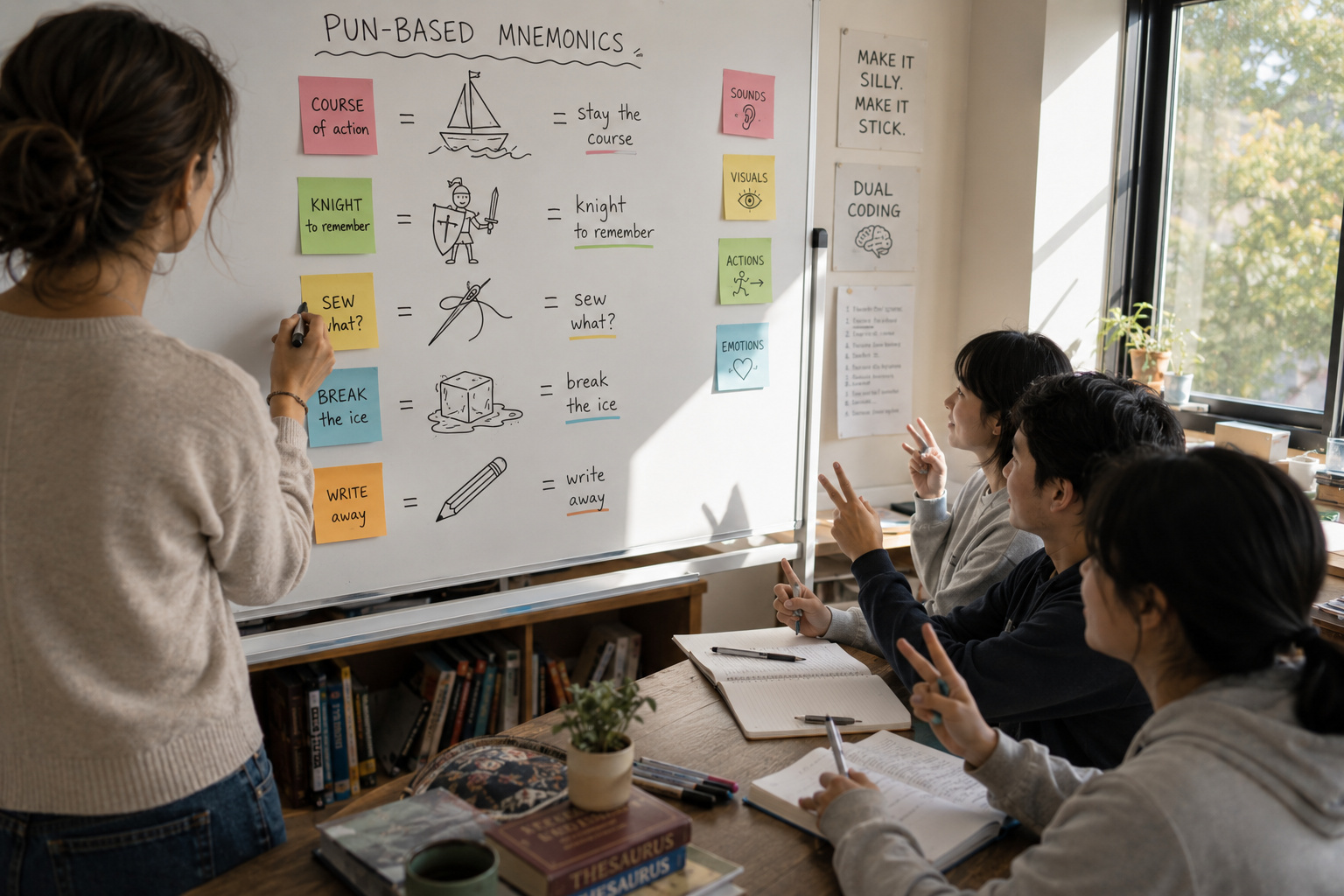
Puns are more than playful jokes; they can be powerful memory aids that make ideas stick. By linking sounds and meanings, clever wordplay creates mental hooks that help recall facts, names, and routines. Educators and communicators often use puns informally to simplify complex ideas into memorable phrases. Whether helping a class remember steps or a team recall names, puns make retrieval easier. This article explores practical ways to employ puns for learning without sacrificing clarity or tone.
Why puns aid memory
Puns create unexpected associations between words and concepts, which boosts encoding and retrieval. When a familiar sound or phrase is repurposed, it captures attention and prompts deeper processing. That novelty increases the chance the information will be stored in long-term memory. Neuroscience and cognitive studies suggest unusual or emotionally resonant cues are easier to retrieve later. Their compact nature makes them easy to rehearse and share.
Used judiciously, these playful links act like lightweight mnemonics that don’t require much effort to recall. They are particularly effective for short lists, names, and routines.
Practical ways to use puns for learning
Start by identifying core terms you want to remember, then brainstorm homophones, rhymes, or double meanings that connect to those terms. Turn those connections into short phrases or one-liners that are easy to repeat aloud. In a classroom or meeting, pair a pun with an image or gesture to strengthen the multisensory memory trace. Repetition spaced over time solidifies the humorous cue into a dependable retrieval pathway.
- Use rhyming pairs to link steps in a process.
- Create name-based puns to remember people or places.
- Attach a physical movement to a pun for kinesthetic recall.
Keep the puns simple and directly tied to the concept to avoid distraction. Testing recall a day later reveals which puns are effective and which need refining.
Balancing humor with clarity
Not every idea benefits from a joke; the best punny mnemonics preserve meaning while adding a memorable twist. Avoid ambiguity that could introduce misconceptions, especially when precision matters. Consider audience tone and familiarity; a pun that delights one group may confuse another. When in doubt, pair the pun with a straightforward explanation so learners can map the playfulness back to the core fact.
Use puns as bridges, not substitutes, for clear instruction. That approach keeps learning both accurate and engaging. Feedback helps tune humor so it consistently aids learning.
Conclusion
Puns are compact tools that can strengthen recall when crafted with purpose. Thoughtful wordplay makes facts stick and conversations livelier without undermining clarity. Try small experiments with puns to discover which ones best support your teaching and remembering.