
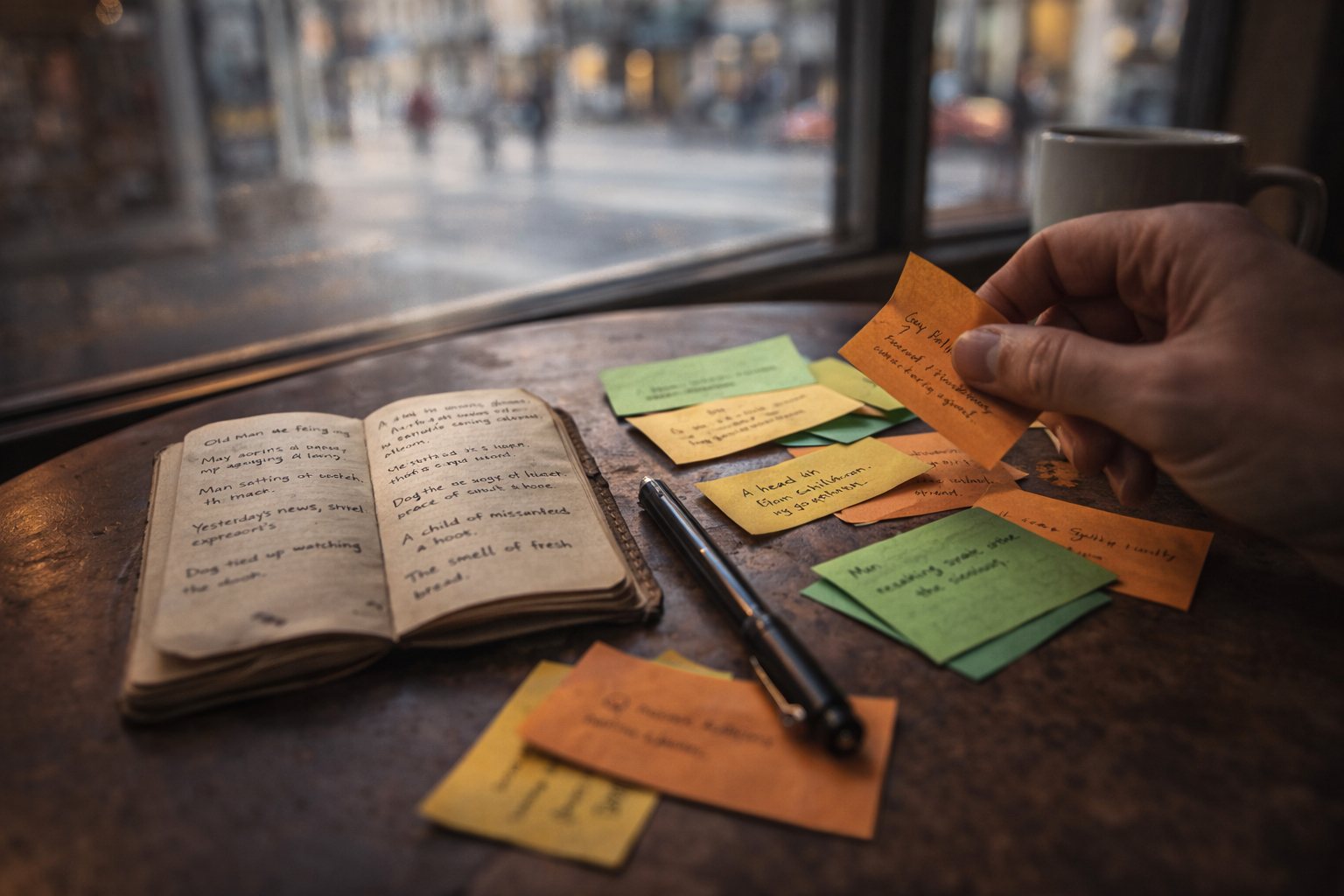
Train yourself to notice the small, odd moments that most people scroll past. Keep a light, portable way to capture them so they don’t evaporate. Practice turning one observation into a single clear image or phrase. Over time you’ll build a catalogue of tiny ideas ready to be shaped into jokes.
Start a Habit of Active Observation
Set aside short, regular windows—five to ten minutes—when you intentionally watch the world without needing to be funny. During those minutes, note anything surprising, inconsistent, or oddly specific. Focus on sensory details: a phrase someone mumbled, an awkward movement, or a tiny contradiction in behavior. This habit trains your brain to spot what can become material for a punchline.
Keep entries brief and literal so you can return to them later. Over weeks the small notes pile up and reveal patterns you can shape into a theme.
Turn Notes into a Reliable Structure
Move from raw observation to a simple structure: setup, tension, payoff. The setup gives the context quickly, the tension creates expectation, and the payoff flips or amplifies that expectation. Aim for clarity: a compact image leads to a stronger surprise when the punchline lands. Test different payoffs on the same setup to discover which angle feels freshest.
- Example approach: state the mundane fact, add a detail that raises a question, deliver an unexpected but logical answer.
- Keep sentences short; comedy breathes in plain language.
When structure sticks, you can recycle the same observation into different jokes for variety. That makes one moment yield several usable lines.
Refine, Test, and Recycle Your Lines
Run your mini-jokes out loud in low-stakes settings: among friends, on a short social clip, or while noting which lines get a smile. Listen to the rhythms and trim anything that slows the momentum. Rewriting is often subtraction; fewer words sharpen the image and increase punch. Pay attention to words that audiences latch onto and keep those as anchors.
Catalog what works and why so you can revisit and adapt ideas later. Over time you’ll build a toolbox of setups and payoffs that mix and match easily.
Conclusion
Make observation a tiny daily ritual and keep your notes accessible.
Practice shaping setups into clean tensions and sharp payoffs.
Test, trim, and reuse lines until a handful of gems become reliable material.